Bio Writer
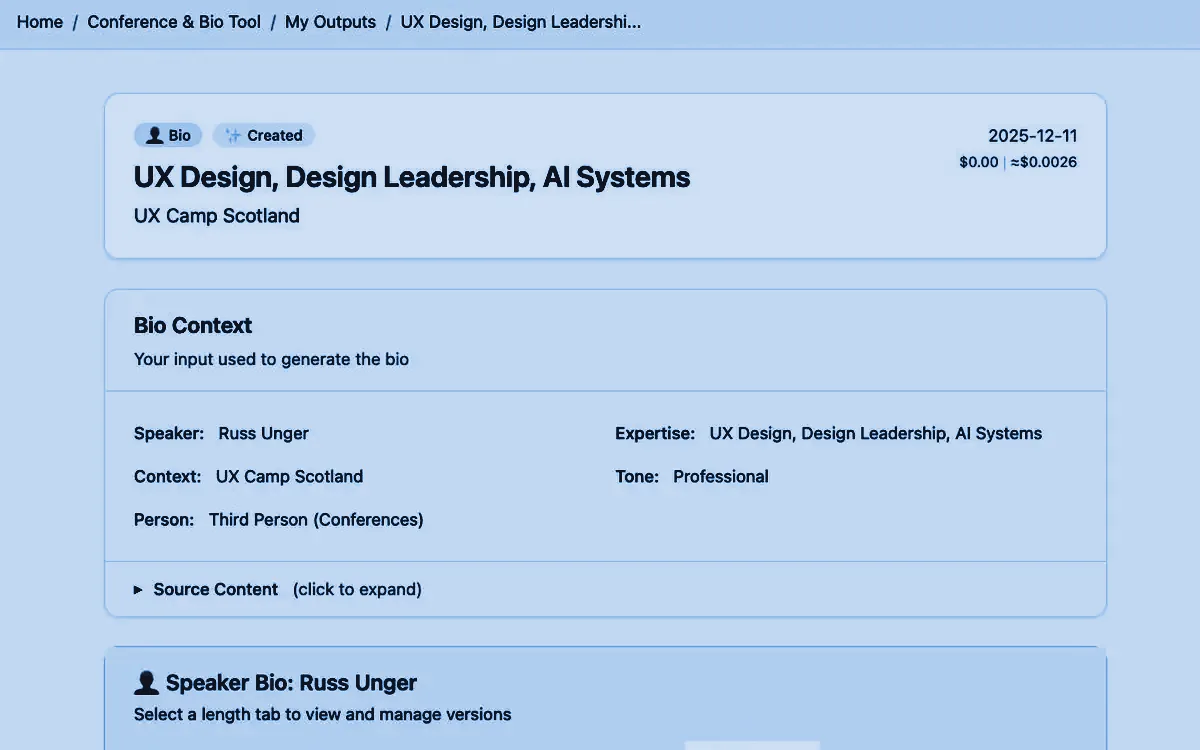
We paste in a speaker’s background and it drafts a conference bio at 100, 150, 200, 250, or 300 words, writing every length we ask for in one run so the comparison is there to read.
It works from two sources on bio writing, chapter three of Speaker Camp and Scott Berkun’s guide, and it retrieves per speaker, so a researcher and an engineer are written from different passages. Each run stands on its own with no memory of the last one, and a length is a target with float, so every bio arrives headed with the number of words it actually runs to next to the number we asked for.
How this works
Paste in what you know about the speaker and the writer retrieves the passages that suit that particular person, then drafts a bio at each length you ticked. Retrieval runs per speaker, so a researcher and an engineer are written from different source material. Every length is its own pass, which is why a run of three takes about half a minute, and nothing you type leaves the bench.
What it reads
Two sources on bio writing: chapter three of Speaker Camp, “Writing Your Bio”, and Scott Berkun’s “How To Write A Good Bio”.
Five rules worth reading before you edit
These five are Berkun’s own.
- Impressive people have short bios
- Write for the real audience
- Invert your pyramid
- Be clever only if you’re certain it’s actually clever
- Watch the slashes, Jack
A length is a target with float
Left alone, the writer runs long, and it runs longer the higher you go. Measured over ninety-one bios, the 150 slot averaged 187 words and the 250 slot averaged 331. Telling it more firmly made no difference, so instead we ask it for fewer words than you ticked and score the result against your number. That takes the average from twenty-seven per cent over to one per cent over, and every length now averages inside ten per cent of what it says.
What we cannot tune away is the spread from one run to the next. The same request lands anywhere inside the range on each chip, so a 150 usually arrives between 135 and 170 words. That is why each bio is still headed with the number of words it actually runs to, with the number you asked for underneath, and why the trimming, or the filling out, is yours to do.
This is a starting point
What comes back is a draft to make your own, not a finished bio. It will get a fact slightly wrong, reach for a phrase you would never say, and miss the thing you most want said, and all of that is easier to fix on the page than from a blank one. Nothing is saved, there is no link to come back to, and each run starts fresh with no memory of the last one.